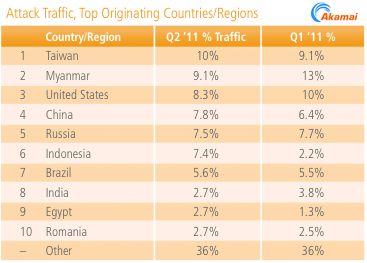
Taiwan has taken the top spot as the world’s dominant source of attack traffic, according to a new report from Akamai Technologies.
In its State of the Internet report for the second quarter of the year, the company found 10 percent of global attack traffic originated from Taiwan, up from 9.1 percent in Q1. Myanmar, the former number one, slipped by second place with 9.1 percent, while the United States rounded out the top three with 8.3.
“Akamai has a set of unadvertised ‘honeypot’ systems whose purpose is to listen for attempts to connect,” David Belson, director of market intelligence at Akamai, told SecurityWeek. “Because these systems are unadvertised, and are separate and distinct from our production service platform, they should not be seeing any sort of attempts to connect on any port. These connection attempts are classified as attack traffic. We record the IP address that is attempting to connect, and use our EdgeScape IP geo-location technology to identify the country where that IP address is located.”
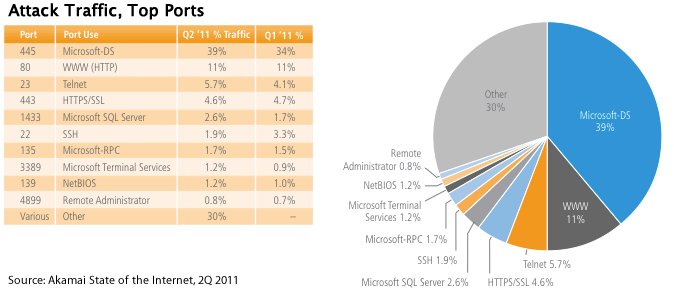
 According to Akamai, attack traffic concentration among the top 10 ports increased slightly from the prior quarter, with the top 10 ports accounting for 70 percent of the observed attacks (up from 65 percent in Q1). Port 445 remained at the top of the list, and the percentage of attacks targeting ports 80 and 443 remained consistent with the first quarter of 2011. The percentage of observed attacks targeting port 25 (SMTP) and port 21 (FTP) dipped to the point where the two ports were dropped from the quarter’s top 10 list, while port 3389 (Microsoft Terminal Services) and port 4899 (remote administrator) reappeared after “a first quarter hiatus.”
Nearly half of the attacks targeting port 80 came from Myanmar. Nearly 70 percent of attacks against Port 1433 (Microsoft SQL Server) originated from China. According to Akamai, the top five ports targeted by attacks originating in China remained the same as in the first quarter, indicating continuing activity among compromised systems searching for unpatched Microsoft applications or weak passwords to exploit.
“From an enterprise perspective, IT/security managers should ensure that their firewalls are locked down appropriately, and that traffic inspection at the applicajavascript:void(0);tion layer is filtering for the appropriate threats, like SQL injection attempts,” Belson said. “From an end user perspective, they should ensure that their OS and applications have the latest patches; they should ensure that they have the appropriate security software installed, configured, and updated; and they should take appropriate care in the sites they go to, e-mails they open, etc.”