
Connect with us

Hi, what are you looking for?

SecurityWeekSecurityWeek

Vulnerabilities

X.Org Flaw Exposes Unix-Like OSes to Attacks

Several Unix-like operating systems are affected by a potentially serious X.Org vulnerability that can be exploited for privilege escalation and arbitrary code execution.

X.Org is a popular open source implementation of the X Windows System (also known as X11, X or X-Windows), the graphical windowing system used by BSD and Linux operating systems.

Several Unix-like operating systems are affected by a potentially serious X.Org vulnerability that can be exploited for privilege escalation and arbitrary code execution.

X.Org is a popular open source implementation of the X Windows System (also known as X11, X or X-Windows), the graphical windowing system used by BSD and Linux operating systems.

Narendra Shinde discovered that X.Org X Server versions 1.19 and later are affected by an arbitrary file overwrite vulnerability that can be exploited by an authenticated attacker to elevate permissions and execute arbitrary code with root privileges.

The security hole, tracked as CVE-2018-14665, was introduced nearly two years ago and it affects operating systems that run X Server with elevated privileges.

“Incorrect command-line parameter validation in the Xorg X server can lead to privilege elevation and/or arbitrary files overwrite, when the X server is running with elevated privileges (ie when Xorg is installed with the setuid bit set and started by a non-root user),” X.Org developers said in an advisory.

The list of impacted operating systems includes Red Hat, CentOS, Debian, Ubuntu, and OpenBSD.

Advertisement. Scroll to continue reading.

Some security experts pointed out that the vulnerability is very easy to exploit — they published a proof-of-concept (PoC) that can fit into a single tweet. While local access is normally required for exploitation, remote attackers can also — in certain circumstances — leverage the vulnerability to take control of a vulnerable system.
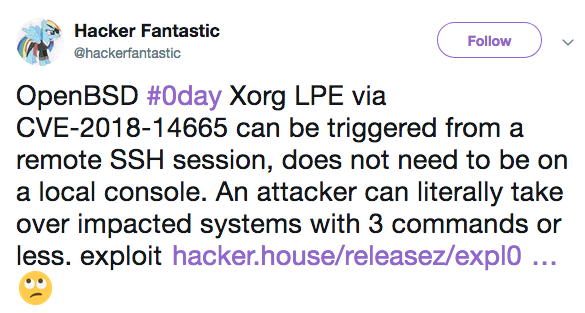
Code execution vulnerability found in X.Org

X.Org developers released a patch on October 25 and operating systems have also started creating fixes. There is also a workaround, but some users may not be able to apply it.

Shinde said he reported the vulnerability to Red Hat on October 10 and X.Org developers two days later. OpenBSD developers, however, were displeased with the fact that they were only notified an hour before the flaw was disclosed.

Related: Linux Kernel Vulnerability Affects Red Hat, CentOS, Debian

Related: ‘SegmentSmack’ Flaw in Linux Kernel Allows Remote DoS Attacks

Related: X.Org Library Flaws Allow Privilege Escalation, DoS Attacks

Written By

Eduard Kovacs (@EduardKovacs) is senior managing editor at SecurityWeek. He worked as a high school IT teacher before starting a career in journalism in 2011. Eduard holds a bachelor’s degree in industrial informatics and a master’s degree in computer techniques applied in electrical engineering.

Daily Briefing Newsletter

Subscribe to the SecurityWeek Email Briefing for the latest cybersecurity threats, trends, and expert insights.

Click to comment

Trending

Daily Briefing Newsletter

Subscribe to the SecurityWeek Email Briefing to stay informed on the latest threats, trends, and technology, along with insightful columns from industry experts.

Join this live webinar as we break down why email-layer defenses alone can't keep pace with the modern phishing ecosystem, how agentic AI is changing the capacity equation for security teams, and more.

Register

This year's summit will help organizations learn how to utilize tools, controls, and design models needed to properly secure cloud environments. Interact with leading solution providers and other end users facing similar challenges in securing a variety of cloud deployments.

Register

People on the Move

Tracey Mustacchio has joined Everfox as Chief Marketing Officer.

Mark Carter has been appointed Chief Information Security Officer at Socure.

Spektrum Labs has named Mark Cravotta Chief Operating Officer.

More People On The Move

Expert Insights

Four decades of incident response experience suggest that exploits are often the symptom, not the root cause, of today’s cybersecurity failures.

Daily Briefing Newsletter

Subscribe to the SecurityWeek Email Briefing to stay informed on the latest cybersecurity news, threats, and expert insights. Unsubscribe at any time.





