
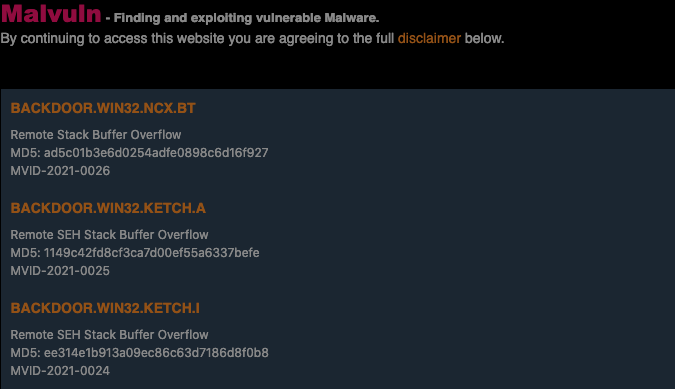
Malvuln has catalogued hundreds of vulnerabilities discovered in malware, and while the project has yet to actually prove useful to anyone, its developer is not discouraged.
Malvuln, an interesting project of security researcher John Page (aka hyp3rlinx), catalogues vulnerabilities discovered in malware and provides information on how those vulnerabilities can be exploited.
Since launching the project in early January 2021, Page has discovered more than 260 vulnerabilities across an estimated 105 individual malware families, including trojans, worms, backdoors, droppers, and ransomware.
The vulnerabilities include issues related to memory corruption, insecure permissions, hardcoded credentials, authentication bypass, directory traversal, and information disclosure. Some of the flaws can be exploited for DoS attacks (i.e. to cause the malware to crash), while others allow unauthenticated “attackers” to remotely execute arbitrary commands — either OS commands on the already-infected system or commands made available by the malware.
When asked if any of the vulnerabilities in Malvuln stand out, the researcher named the unauthenticated remote command execution flaws, which he described as “easy wins.”
When he launched the project, Page told SecurityWeek that at one point the information on Malvuln could become useful to someone — for example, incident response teams could disable a piece of malware without touching the machine, if the exploit is remote. However, until now, Malvuln does not appear to have been useful to anyone in the cybersecurity community. On the other hand, the researcher says he runs the project for himself, for fun.
When Malvuln was announced, some members of the industry expressed concern about the information being useful to bad actors, and that it could hamper ongoing research into malicious activity.
“Some may not take the project seriously or think it’s a waste of time, but I don’t care and don’t expect anything. If something comes of it, ok, if not, don’t care,” Page told SecurityWeek via email over the weekend.
All the vulnerabilities catalogued to date were found by Page himself. In the past, he suggested that he could at one point start accepting third-party contributions, but right now he says he doesn’t want to “deal with anyone.”
The researcher says he has not invested a lot of time in the project. “Didn’t bother to track it, but [the time invested is] pretty minimal — do it in my spare time, basically for fun.”
Page says he has some new ideas for the project, but he does not want to share them right now.
Related: Community Project Crushes 100,000 Malware Sites in 10 Months
Related: University Project Tracks Ransomware Attacks on Critical Infrastructure
Related: Free Microsoft Service Looks at OS Memory Snapshots to Find Malware






