
Connect with us

Hi, what are you looking for?

SecurityWeekSecurityWeek

Cybercrime

EU Adopts New Response Protocol for Major Cyberattacks

Europol on Monday announced the adoption of a new protocol for how law enforcement authorities in the European Union and beyond will respond to major cross-border cyberattacks.

Europol on Monday announced the adoption of a new protocol for how law enforcement authorities in the European Union and beyond will respond to major cross-border cyberattacks.

The new EU Law Enforcement Emergency Response Protocol should prove useful in case of major attacks such as the ones involving WannaCry and NotPetya malware, which in 2017 hit hundreds of thousands of systems around the world and caused significant losses for many organizations.

The new protocol, adopted by the Council of the EU, is part of the EU’s Blueprint for Coordinated Response to Large-Scale Cross-Border Cybersecurity Incidents and Crises, and it will be implemented by Europol’s European Cybercrime Centre (EC3). It focuses on rapid assessment, sharing of information, and coordination of the international aspects of an investigation.

The protocol only covers malicious and criminal cyber incidents — Europol highlighted that it does not cover incidents caused by natural disasters or ones resulting from human error or system failure. Its goal is to complement existing crisis management mechanisms.

The protocol has seven main components: early detection and identification of a major cyberattack, classification of the threat, establishing a coordination center for emergency response, early warning notifications, an operational action plan for law enforcement, investigation of the incident, and emergency response protocol closure.
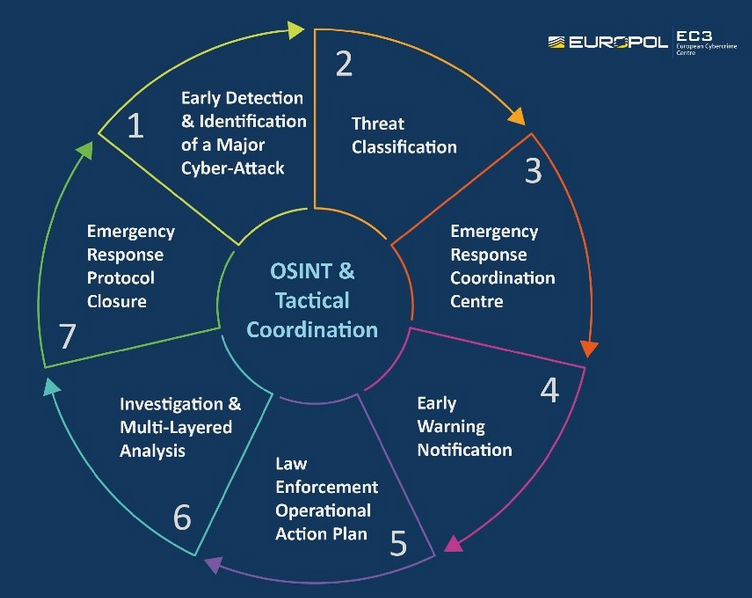
EU Law Enforcement Emergency Response Protocol

“The EU Law Enforcement Emergency Response Protocol determines the procedures, roles and responsibilities of key players both within the EU and beyond; secure communication channels and 24/7 contact points for the exchange of critical information; as well as the overall coordination and de-confliction mechanism,” Europol said.

Advertisement. Scroll to continue reading.

Related: Europol, Diebold Nixdorf to Share Information on Cyber Threats

Related: Europol Creates Dark Web Investigations Team

Related: Hackers Linked to Luminosity RAT Targeted by Law Enforcement

Written By

Eduard Kovacs (@EduardKovacs) is senior managing editor at SecurityWeek. He worked as a high school IT teacher before starting a career in journalism in 2011. Eduard holds a bachelor’s degree in industrial informatics and a master’s degree in computer techniques applied in electrical engineering.

Daily Briefing Newsletter

Subscribe to the SecurityWeek Email Briefing for the latest cybersecurity threats, trends, and expert insights.

Click to comment

Trending

Daily Briefing Newsletter

Subscribe to the SecurityWeek Email Briefing to stay informed on the latest threats, trends, and technology, along with insightful columns from industry experts.

Join this live webinar for a practical framework for evolving your AI security program from a single application to an enterprise AI ecosystem and autonomous agents.

Register

In this live webinar, learn how to define your minimum viable business, identify the systems it depends on, measure actual recovery time against business requirements, and present the gaps to the board as measurable risk.

Register

People on the Move

Social engineering protection company Doppel has promoted Alyssa Smrekar to Chief Marketing Officer.

Naveen Bhateja has been appointed Chief People Officer at HackerOne.

The Department of War has appointed Sonu Shankar as Principal Deputy Chief Information Officer.

More People On The Move

Expert Insights

Daily Briefing Newsletter

Subscribe to the SecurityWeek Email Briefing to stay informed on the latest cybersecurity news, threats, and expert insights. Unsubscribe at any time.





