
Over 60% of Sites Loaded via Chrome Use HTTPS, Says Google
The number of websites that protect traffic using HTTPS has increased considerably in the past months, according to data shared by Google last week.
The tech giant says 64% of websites loaded via Chrome on Android are now protected by HTTPS, up from 42% one year ago. There is also a significant improvement in the case of Mac and Chrome OS – in both cases, 75% of Chrome traffic is protected, up from 60% and 67%, respectively.
Data from Google shows that 67% of Chrome traffic on Windows goes through an HTTPS connection, up from 40% in July 2015 and nearly 50% in July 2016.
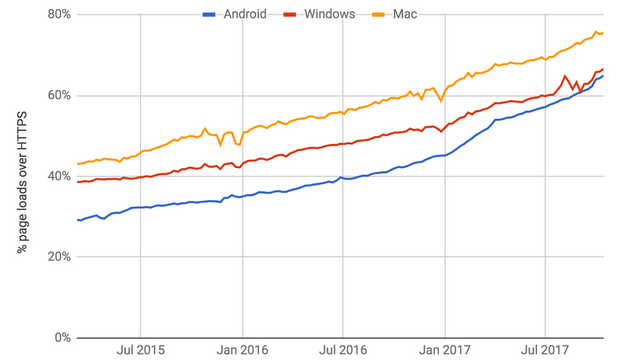
As for popular websites, Google says 71 of the top 100 sites on the Web use HTTPS by default, compared to 37 one year ago.
When analyzed based on geographical location, the data shows significant improvements in several countries, including the United States (from 59% to 73%), Japan (from 31% to 55%) and Brazil (from 50% to 66%).
Google’s efforts to boost HTTPS adoption include displaying warnings in Chrome for sites that use HTTP when receiving user data, sponsoring the Let’s Encrypt certificate authority, and adding statistics on HTTPS to its transparency report.
“HTTPS is easier and cheaper than ever before, and it enables both the best performance the web offers and powerful new features that are too sensitive for HTTP. There’s never been a better time to migrate!” Emily Schechter, Chrome Security Product Manager, said in a blog post.
While the number of legitimate websites using HTTPS has increased in the past months, so has the number of phishing sites leveraging HTTPS. Netcraft reported in May that the proportion of phishing websites using HTTPS had increased from roughly 5% to 15% since late January.
Google has made several security-related announcements recently, including the expansion of its HSTS preload list, stronger security for “high risk” users, and new phishing protections.
Related: U.S. Warns of Security Issues With HTTPS Inspection Products
Related: HTTPS Security Weakened by AV Products, Middleboxes






