
Effective and efficient use of complex agentic systems is important for all organizations, but recognizing, preventing and recovering from them going rogue could be an existential necessity.
NIST, the NSA, and CISA recognize the increasing potential for AI agents to behave in an unexpected and potentially harmful manner, and has responded with a list of key practices for both preparing for and responding to such behavior. The report (Key Practices for Incident Readiness and Response in Super Intelligence Training and Evaluation) uses the term super intelligence (SI) rather than artificial intelligence (AI) in line with presidential executive order 14434.
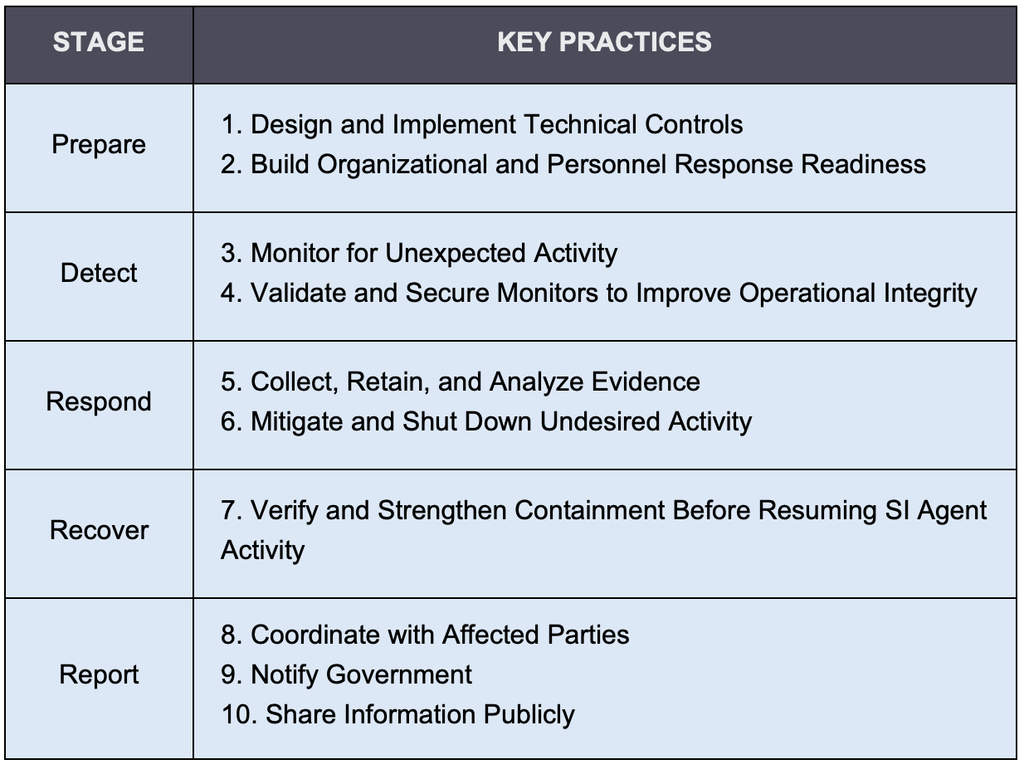
In the report, the ten key practices are grouped into five stages: prepare, detect, respond, recover, and report. For clarity, the report also includes three useful terminology definitions covering AI agents, AI control incident, and AI control near-miss.
“The practices are intended to help the frontier SI industry prevent, prepare for, and respond rapidly to incidents in which SI systems do not act as intended or authorized,” the agencies explain.
Preparation includes activities such as asset and risk inventories, defense-in-depth, least privilege, zero-trust controls, credential management, supply chain risk management and more.
Detection requires continuous monitoring for correct behavior, and anomalous activity and indications of compromise.
Response entails isolating affected systems, revoking credentials, rebuilding compromised environments, determining the blast radius, and conducting root-cause analysis that looks past the specific vulnerability exploited.
Recovery requires testing restoration procedures in advance and documenting recovery decisions along with any residual risk accepted.
Reporting requirements are three-fold: report incidents to all affected parties, wherever required by law, and publicly and widely.
None of the stages or practices is given any greater weight over the others. Instead, the five stages should be treated as a single target. Complex agents all have the potential for misbehavior bordering on rogue and dangerous. These ten practices combine to help organizations develop a stable and effective environment for complex agentic systems, where problems can be detected early and effective operation maintained.
Only the final two practices (#9 and #10 in the Report stage) go beyond the more technical steps of incident readiness and response.
The first of these, ‘Notify Government’, may be a legal requirement, including: “Adhere to any applicable legal reporting requirements, including cybersecurity incident reporting obligations to CISA, law enforcement, and/or cyber-defense organizations.”
The last, Share Information Publicly, is mainstream good behavior throughout cybersecurity that will benefit everyone: “Share details with the public, where appropriate, as early as feasible,” and “Identify and publicly report key practices, takeaways, or improvements adopted in response to the incident or that could benefit other actors in the ecosystem.”
The value of this document is not in providing any new or unrecognized information for AI agent governance, but in providing a very clear and thorough checklist for use by security professionals to maximize the use of agents while minimizing or recovering from agentic incidents.
Related: Reco Raises $55 Million for Agentic Security
Related: Rig Security Emerges From Stealth With $12M to Tackle Agentic AI Identity Risks
Related: Begin at the End: How to Enable Agentic Remediation
Related: HelmGuard Raises $7.3 Million for Agentic GRC and Security