

The non-profit MITRE Corporation this week published a revised CWE Most Important Hardware Weaknesses (MIHW) to align it with the evolution of the hardware security landscape.
Initially released in 2021, the CWE MIHW list includes frequent errors that lead to critical hardware vulnerabilities, and is meant to raise awareness within the community, to help eradicate hardware flaws from the start.
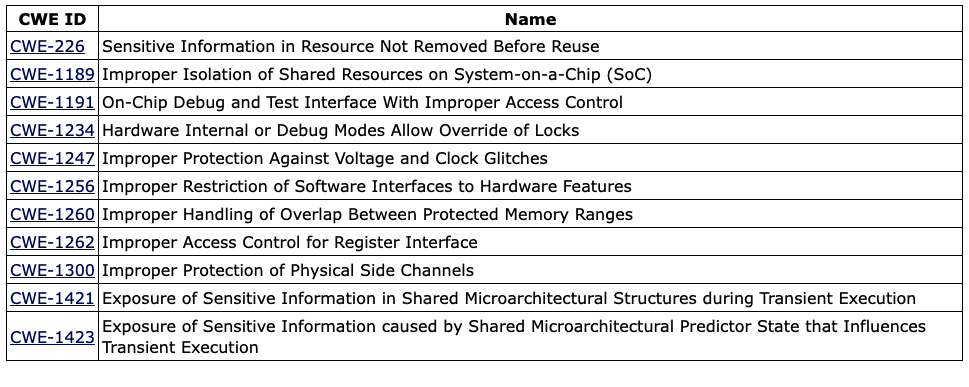
The updated list includes 11 entries and comes with new classes, categories, and base weaknesses, but retains five of the entries that were included in the 2021 CWE MIHW list. It shows a focus on resource reuse, debug mode bugs, and fault injection.
‘CWE-226: Sensitive Information in Resource Not Removed Before Reuse’ is at the top of MITRE’s 2025 CWE MIHW list.
It refers to resources that are released and may be made available for reuse without being properly cleared. If memory, for example, is not cleared before it is made available to a different process, data could become available to less trustworthy parties.
“This weakness can apply in hardware, such as when a device or system switches between power, sleep, or debug states during normal operation, or when execution changes to different users or privilege levels,” CWE-226’s description reads.
Second on the revised list is ‘CWE-1189: Improper Isolation of Shared Resources on System-on-a-Chip (SoC)’, which was at the top four years ago.
Other entries that were kept from the previous version of the list include ‘CWE-1191: On-Chip Debug and Test Interface With Improper Access Control’, ‘CWE-1256: Improper Restriction of Software Interfaces to Hardware Features’, ‘CWE-1260: Improper Handling of Overlap Between Protected Memory Ranges’, and ‘CWE-1300: Improper Protection of Physical Side Channels’.
“These entries represent persistent challenges in hardware security that are both theoretically significant and commonly observed in practice. Their continued inclusion, even with the shift to a hybrid expert and data-driven selection process, underscores their ongoing importance,” MITRE notes.
Of the six new CWEs that made it to the revised MIHW list, two were added to the CWE after the 2021 MIHW list was released.
In addition to the 11 weaknesses included in the main MIHW list, MITRE warns of five others that are also highly important and could lead to serious security defects. These include four entries that were in the previous iteration of the list.
“Hardware weaknesses propagate upward: once embedded in silicon, they constrain software, firmware, and system-level mitigations. Engineers working at higher layers need to understand that some risks are inherited and may never be fully remediated at their level. That makes transparency from vendors, independent evaluation ecosystems, and better incentives for proactive security in design critical,” NCC Group managing security consultant Liz James said.
Related: MITRE Unveils AADAPT Framework to Tackle Cryptocurrency Threats
Related: MITRE Publishes Post-Quantum Cryptography Migration Roadmap
Related: MITRE CVE Program Gets Last-Hour Funding Reprieve
Related: MITRE Updates List of 25 Most Dangerous Software Vulnerabilities






