
Tens of thousands of internet-exposed Microsoft Exchange servers appear to be affected by the ProxyShell vulnerabilities, and they could get compromised at any moment considering that threat actors are already scanning the web for vulnerable devices.
ProxyShell is the name given to a series of vulnerabilities — CVE-2021-34473, CVE-2021-34523 and CVE-2021-31207 — that can be chained for unauthenticated remote code execution, allowing an attacker to take complete control of an Exchange server.
The flaws were discovered by Orange Tsai, principal researcher at security consulting firm DEVCORE, and they were first demonstrated at the Pwn2Own hacking competition earlier this year.
The researcher says Microsoft released patches in mid-April, but advisories for the vulnerabilities were only published in May and July.
Orange Tsai disclosed technical details about the ProxyShell vulnerabilities at the Black Hat and DEF CON conferences last week and, shortly after, other researchers published their own analysis.
Researcher Kevin Beamont then reported that attackers had apparently started scanning the internet for vulnerable Exchange servers. The researcher said his Exchange honeypot had recorded attempts to drop files and execute commands. Threat intelligence company Bad Packets has also reported seeing “ProxyShell events.”
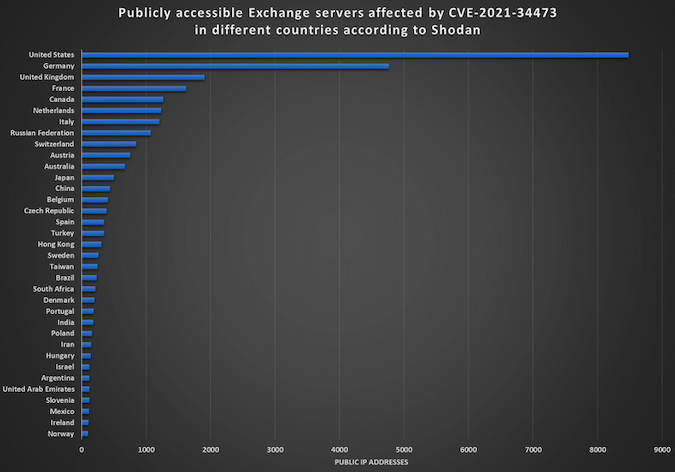
The SANS Institute’s Jan Kopriva used the Shodan search engine to determine how many internet-exposed Exchange servers are vulnerable to ProxyShell attacks. His search showed roughly 30,000 systems affected by the three ProxyShell vulnerabilities, but he noted that the number could increase significantly over the coming days due to the fact that Shodan likely had not scanned the entire internet by the time he conducted the search.
When the ProxyLogon vulnerabilities came to light earlier this year, it was a similar situation, where the number of affected Exchange servers increased sharply over the first week.
In the case of ProxyShell, roughly 8,500 of the 30,000 servers identified in the initial scan are located in the United States, followed by Germany (roughly 5,000), the United Kingdom (roughly 2,000), France, Canada, the Netherlands, Italy, and Russia.
Beamont has made available indicators of compromise (IOCs), as well as an open source tool that can be used by security teams to check their servers.
Related: U.S., Allies Officially Accuse China of Microsoft Exchange Attacks
Related: CISA Details Malware Found on Hacked Exchange Servers
Related: Over 80,000 Exchange Servers Still Affected by Actively Exploited Vulnerabilities






