Connect with us

Hi, what are you looking for?

SecurityWeekSecurityWeek

Endpoint Security

Checkpoint Creates Encyclopedia of Malware Evasion Techniques

Cybersecurity firm Checkpoint has created an encyclopedia of the various techniques used by malware to evade analysis.

Cybersecurity firm Checkpoint has created an encyclopedia of the various techniques used by malware to evade analysis.

The encyclopedia covers evasion techniques related to the file system, registry, generic OS queries, global OS objects, user interface artifacts, OS features, processes, network, CPU, firmware tables, hooks, hardware, and macOS-specific sandboxes.

Checkpoint also plans on adding evasion techniques related to timing, Windows Management Instrumentation (WMI), and human-like behavior. The company has also created a GitHub page where experts can contribute to the encyclopedia.

Each evasion category includes a description of the technique, code samples, signature recommendations for tracking attempts to use the technique, a table showing the type of environments that can be detected, and countermeasures.
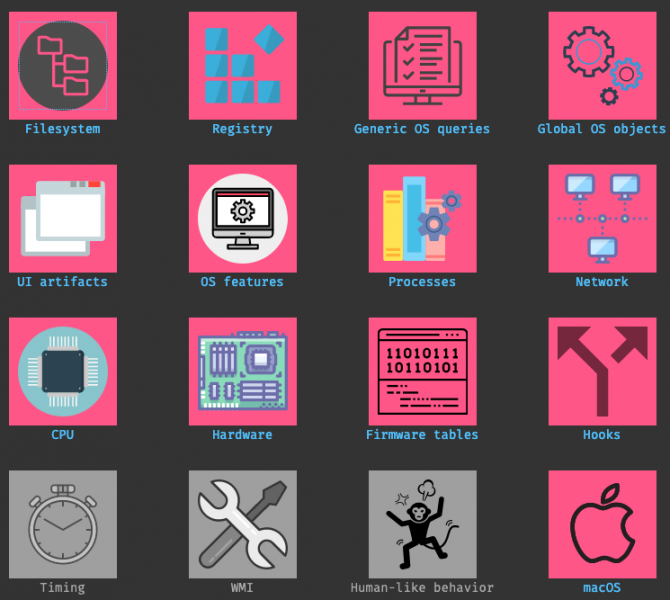
Malware evasion techniques

Several tools that demonstrate these evasion techniques are already publicly available as open source. However, Checkpoint has also released its own open source tool, named InviZzzible.

Cybersecurity companies often use automated solutions to analyze malware samples and their behavior, and malware developers have become increasingly good at identifying these types of virtual environments.

Advertisement. Scroll to continue reading.

Many pieces of malware are designed to either completely stop working or behave differently when an analysis environment is encountered. Defenders, on the other hand, have to work on improving their analysis systems to trick malware into believing that it’s running on a regular device.

Related: Three Strategies to Combat Anti-Analysis and Evasion Techniques

Related: Dexphot Malware Uses Randomization, Encryption, and Polymorphism to Evade Detection

Related: Evasive Malware Now a Commodity

Related: ‘Process Doppelgänging’ Helps Malware Evade Detection

Written By

Eduard Kovacs (@EduardKovacs) is senior managing editor at SecurityWeek. He worked as a high school IT teacher before starting a career in journalism in 2011. Eduard holds a bachelor’s degree in industrial informatics and a master’s degree in computer techniques applied in electrical engineering.

Daily Briefing Newsletter

Subscribe to the SecurityWeek Email Briefing for the latest cybersecurity threats, trends, and expert insights.

Click to comment

Trending

Daily Briefing Newsletter

Subscribe to the SecurityWeek Email Briefing to stay informed on the latest threats, trends, and technology, along with insightful columns from industry experts.

Organizations are investing heavily in third-party risk management, but breaches, delays, and blind spots continue to persist. Join this live webinar as we examine the gap between how organizations think their third-party risk programs are performing and what’s actually happening in practice.

Register

Explore how attackers are using AI to scale threats and how security teams can respond with AI-driven defenses. Protecting against unmonitored use of generative AI (Shadow AI) in business units and building and enforcing AI governance frameworks.

Register

People on the Move

Cyera has appointed Naveen Palavalli as Chief Marketing Officer.

Connie Devine has been promoted to Chief Information Security Officer at Phillips 66.

Jeff Lunglhofer becomes Chief Security Officer at Coinbase, replacing Philip Martin.

More People On The Move

Expert Insights

Daily Briefing Newsletter

Subscribe to the SecurityWeek Email Briefing to stay informed on the latest cybersecurity news, threats, and expert insights. Unsubscribe at any time.