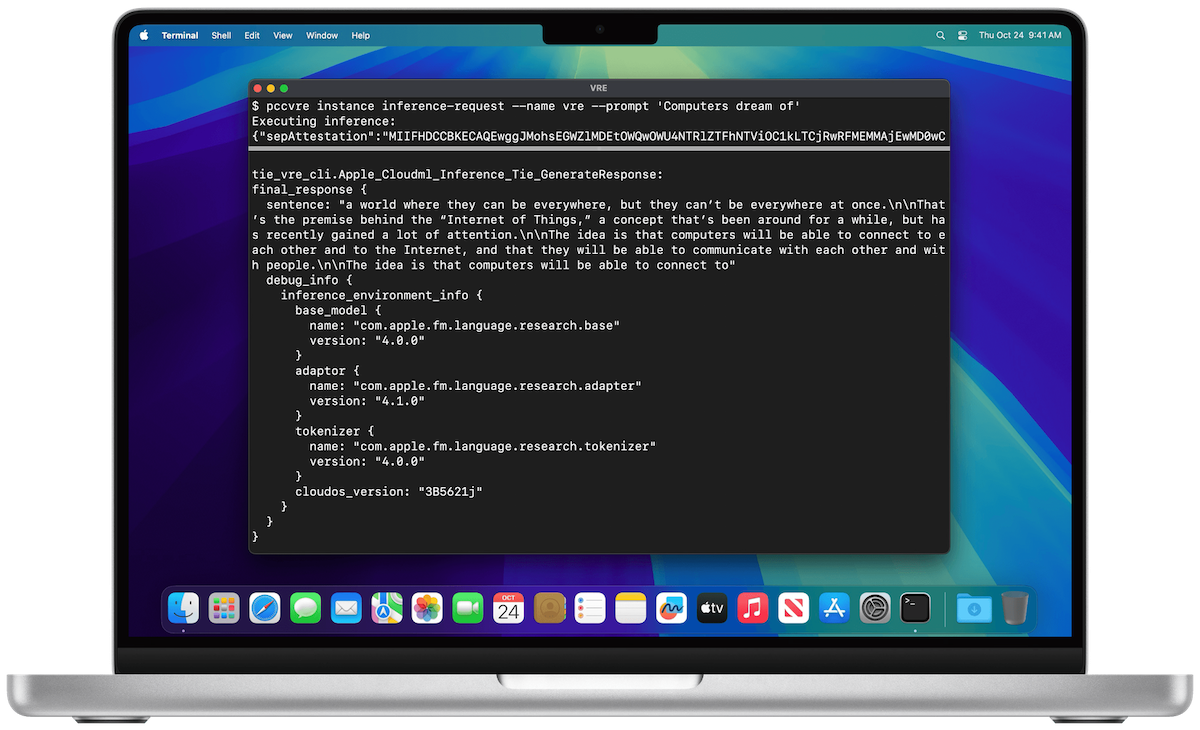
Apple has introduced new tools and launched a virtual research lab to enable public inspection and verification of the security and privacy claims of the Private Cloud Compute technology integrated into modern iPhones.
The Cupertino, Calif. device and OS maker said the tooling is meant to provide “verifiable transparency” of its promises to secure data within its Apple Intelligence AI-powered features.
Apple’s security engineering team released a detailed security guide to help researchers and enthusiasts to understand the design of the PCC architecture. The guide includes technical details about the components of PCC and how they work together to make privacy-related promises around AI data processing in the cloud.
Apple said the guide covers topics like how PCC attestations build on an immutable foundation of features implemented in hardware; how PCC requests are authenticated and routed to provide non-targetability; how Apple technically ensures users can inspect the software running in Apple’s data centers; and how PCC’s privacy and security properties hold up in various attack scenarios.
A separate Virtual Research Environment was also released to offer researchers access to the same environment used to run PCC nodes, allowing them to analyze and test the platform’s integrity.
Apple said the VRE operates on macOS, enabling users to list and inspect software releases, verify the consistency of transparency logs, boot releases in virtual environments, and run inference tests.
The virtual lab also offers a virtual Secure Enclave Processor (SEP), enabling the first-ever security research on this component in a virtualized setting, Apple said.
Apple also released source code for key components of the PCC through GitHub, including CloudAttestation (ensures the validity of PCC node attestations), Thimble (manages transparency enforcement on devices), splunkloggingd (filters logs to prevent unintentional data disclosures), and srd_tools (provides tooling to operate the VRE).
The company also added the Private Cloud Compute stack to its bug bounty program with cash rewards for identifying vulnerabilities that compromise the privacy and security of the system. Apple said PCC findings would qualify for bounties in the range of $50,000 to $1 million, with categories targeting critical risks like unintended data disclosure and remote code execution outside the trust boundary.
“Building on our experience with the Apple Security Research Device Program, the tooling and documentation that we released today makes it easier than ever for anyone to not only study, but verify PCC’s critical security and privacy features,” Apple said.
“We believe Private Cloud Compute is the most advanced security architecture ever deployed for cloud AI compute at scale, and we look forward to working with the research community to build trust in the system and make it even more secure and private over time,” the company added.
Apple’s tooling follows Microsoft’s security-themed overhaul of the Windows Recall AI search tool over privacy and security concerns. The redesign added proof-of-presence encryption, anti-tampering and DLP checks, and screenshot data managed in secure enclaves outside the main operating system.
Related: Windows Recall Returns With Proof-of-Presence Encryption, Data Isolation
Related: Microsoft Bows to Pressure, Disables Windows Recall by Default
Related: Apple Adding End-to-End Encryption to iCloud Backup
Related: Apple ‘Lockdown Mode’ Thwarts .Gov Mercenary Spyware
Related: Can ‘Lockdown Mode’ Solve Apple’s Mercenary Spyware Problem?