
Connect with us

Hi, what are you looking for?

SecurityWeekSecurityWeek

Malware & Threats

ZeuS Goes Mobile – Targets Online Banking Two Factor Authentication

Over the weekend, researchers from Fortinet and S21cec came across a new mobile malware piece they have named SymbOS/Zitmo.A!tr, or “Zitmo,” standing for “Zeus In The Mobile.” As two-factor authentication methods become more popular, cybercriminals are working hard to keep up and develop technologies that let them further track and capture user credentials. The Zitmo malware was designed to intercept confirmation SMS messages sent by banks to their customers.

Over the weekend, researchers from Fortinet and S21cec came across a new mobile malware piece they have named SymbOS/Zitmo.A!tr, or “Zitmo,” standing for “Zeus In The Mobile.” As two-factor authentication methods become more popular, cybercriminals are working hard to keep up and develop technologies that let them further track and capture user credentials. The Zitmo malware was designed to intercept confirmation SMS messages sent by banks to their customers.

In order to successfully overcome two-factor authentication, the attacker steals login credentials using the traditional ZeuS malware. The attacker also captures the phone number and model of the users mobile device via injection of HTML forms in the victims’ browser. Based on that info, it encourages users to install mobile malware, by sending a SMS with a link to download the appropriate version of the malicious package depending on the type of mobile device the user has.
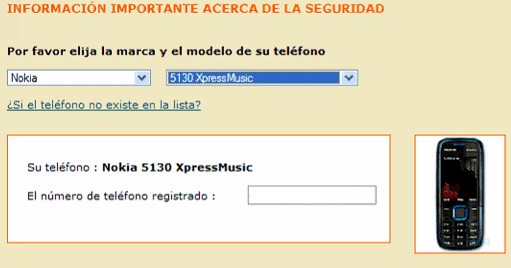
ZeuS Mobile Malware (Zitmo)

Next, the attacker logs in with the stolen credentials using the user’s computer as a proxy and performs the SMS authentication process. An SMS is sent to the user’s mobile device with the authentication code. The malicious software running on the user’s mobile device forwards the SMS to a system controlled by the attacker.

After analyzing the malware, Fortinet noted that it creates its own database on the mobile device, where it stores all information it steals. This database is named NumbersDB.db, and contains 3 tables:

• tbl_contact with 4 columns: index, name, descr, pb_contact_id.

• tbl_phone_number with 2 columns: contact_id, phone_number

Advertisement. Scroll to continue reading.

• and tbl_history with 6 columns: event_id, pn_id, date, description, contact_info, contact_id.

The malware searches those tables using standard SQL queries. The malware sends SMS messages. In particular, it sends a message to a phone number located in the United Kingdom to notify that the malware has been successfully installed (”App installed ok”). “27/09/2010″,”12:09″,”Short message”,”Outgoing”,”App installed ok”,”+44778xxxxxxx”

Additionally, s21sec warns that the malware appears to have the capability to answer commands, potentially allowing anyone sending a “set admin” SMS to your infected phone may to take control of it.


Written By

For more than 15 years, Mike Lennon has been closely monitoring the threat landscape and analyzing trends in the National Security and enterprise cybersecurity space. In his role at SecurityWeek, he oversees the editorial direction of the publication and is founder and director of several leading cybersecurity industry conferences around the world.

Daily Briefing Newsletter

Subscribe to the SecurityWeek Email Briefing for the latest cybersecurity threats, trends, and expert insights.

Click to comment

Trending

Daily Briefing Newsletter

Subscribe to the SecurityWeek Email Briefing to stay informed on the latest threats, trends, and technology, along with insightful columns from industry experts.

Join this live webinar for a practical framework for evolving your AI security program from a single application to an enterprise AI ecosystem and autonomous agents.

Register

In this live webinar, learn how to define your minimum viable business, identify the systems it depends on, measure actual recovery time against business requirements, and present the gaps to the board as measurable risk.

Register

People on the Move

Vensure Employer Solutions appointed Michael Lockhart as Chief Information Security Officer.

WISeKey has appointed Alexander Hirsch as Group Chief Marketing Officer.

UltraViolet Cyber has named Andrew Park Chief Information Security Officer.

More People On The Move

Expert Insights

Daily Briefing Newsletter

Subscribe to the SecurityWeek Email Briefing to stay informed on the latest cybersecurity news, threats, and expert insights. Unsubscribe at any time.




