
Connect with us

Hi, what are you looking for?

SecurityWeekSecurityWeek

Endpoint Security

Microsoft Announces Public Preview of Application Guard for Office

Microsoft informed administrators on Monday that Application Guard for Office, a feature designed to protect users against malicious documents, is now available in public preview.

Microsoft informed administrators on Monday that Application Guard for Office, a feature designed to protect users against malicious documents, is now available in public preview.

Application Guard for Office (its full name is Microsoft Defender Application Guard for Office) has been available in private preview. The feature, which is currently disabled by default, is available to customers who have a 365 E5 or 365 E5 Security license.

Application Guard for Office prevents untrusted files from accessing trusted resources by running potentially unsafe Office files in a secure container isolated through hardware-based virtualization.

“When Office opens files in Application Guard, users can securely read, edit, print, and save those files without having to re-open files outside the container,” explained Eric Wayne, a senior Office deployment engineer at Microsoft.

Microsoft has provided detailed instructions for enabling Application Guard for Office. The company pointed out that when the feature is enabled, users will be informed both in the Office splash screen when they open an untrusted file, and while they are working with the opened file.
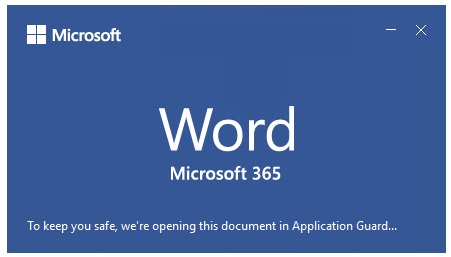
Microsoft Application Guard for Office

Microsoft is also offering Windows Defender Application Guard for its Edge and Internet Explorer web browsers, which is designed to provide protection against malicious files downloaded from the internet.

Advertisement. Scroll to continue reading.

Related: Microsoft Brings Safe Documents, Application Guard to More 365 ProPlus Users

Related: Microsoft Makes Automated Incident Response in Office 365 ATP Available

Related: Microsoft Adds New Security Features to Office 365

Related: Researcher Details Sophisticated macOS Attack via Office Document Macros

Written By

Eduard Kovacs (@EduardKovacs) is senior managing editor at SecurityWeek. He worked as a high school IT teacher before starting a career in journalism in 2011. Eduard holds a bachelor’s degree in industrial informatics and a master’s degree in computer techniques applied in electrical engineering.

Daily Briefing Newsletter

Subscribe to the SecurityWeek Email Briefing for the latest cybersecurity threats, trends, and expert insights.

Click to comment

Trending

Daily Briefing Newsletter

Subscribe to the SecurityWeek Email Briefing to stay informed on the latest threats, trends, and technology, along with insightful columns from industry experts.

Join this live webinar as we break down why email-layer defenses alone can't keep pace with the modern phishing ecosystem, how agentic AI is changing the capacity equation for security teams, and more.

Register

This year's summit will help organizations learn how to utilize tools, controls, and design models needed to properly secure cloud environments. Interact with leading solution providers and other end users facing similar challenges in securing a variety of cloud deployments.

Register

People on the Move

Mark Carter has been appointed Chief Information Security Officer at Socure.

Spektrum Labs has named Mark Cravotta Chief Operating Officer.

Philip Martin has joined Uber as Chief Information Security Officer.

More People On The Move

Expert Insights

Four decades of incident response experience suggest that exploits are often the symptom, not the root cause, of today’s cybersecurity failures.

Daily Briefing Newsletter

Subscribe to the SecurityWeek Email Briefing to stay informed on the latest cybersecurity news, threats, and expert insights. Unsubscribe at any time.





