Google Cloud this week announced an always-on autonomous platform designed to protect enterprises from the rising wave of AI-powered cyberattacks.
The new Google AI Threat Defense cybersecurity solution leverages AI to identify machine-powered threats faster and stop them before they can do harm.
According to Google, the platform continuously prioritizes critical real-world risks and can help organizations implement defenses that predict attack paths and proactively deploy remediation.
Google AI Threat Defense combines Mandiant’s frontline and incident response experience with Wiz’s cloud security platform (recently acquired by Google) and Gemini’s reasoning and code remediation capabilities powered by Gemini and CodeMender.
“By connecting real-world exposure directly to autonomously creating and prioritizing patching, AI Threat Defense helps organizations actively predict attack paths, prioritize the most significant threats, and deploy verified fixes faster than adversaries can exploit them,” Google says.
[Learn More: SecurityWeek to Host AI Risk Summit August 11-12 at the Ritz-Carlton, Half Moon Bay]
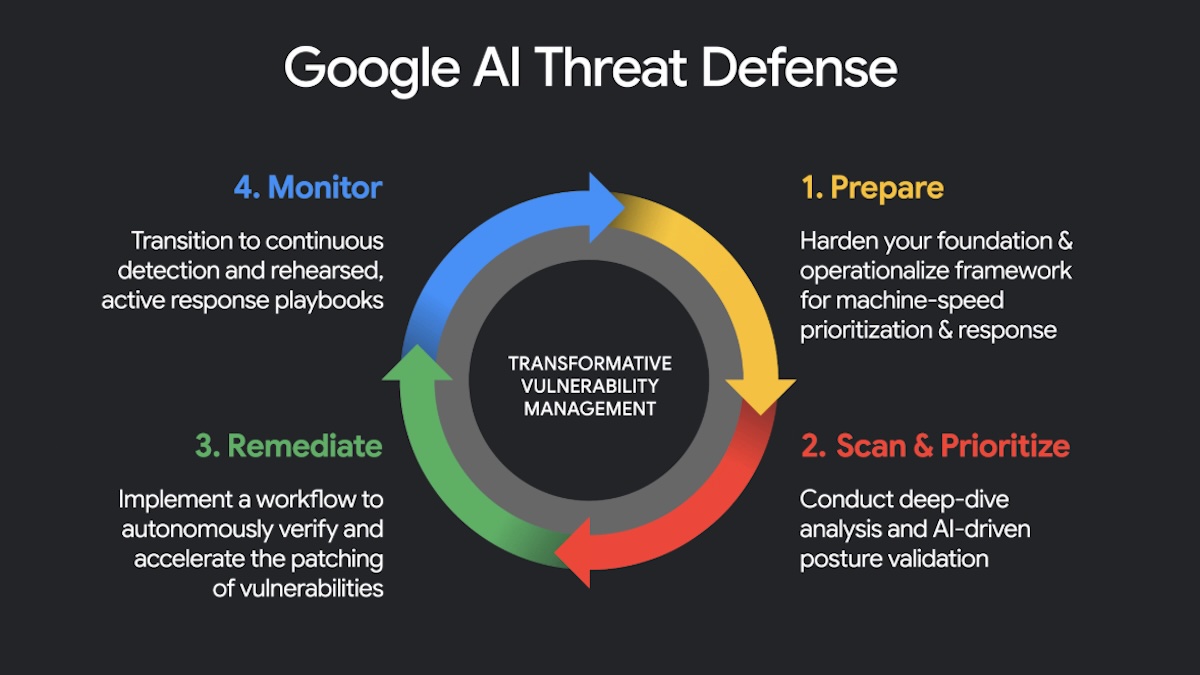
To match the speed of attackers and help organizations surface weaknesses in their software, AI Threat Defense uses the same four-step framework that the internet giant is relying on to stop threats and transform vulnerability management.
It involves mapping the environment for asset visibility, conducting deep-dive assessments and AI-driven posture validation, implementing workflows for fast, autonomous vulnerability remediation, and implementing machine-speed detection and response.
The first step, Google says, requires exposure reduction by making sensitive assets unreachable from the internet. Each organization also needs to understand its time to remediation and its ability to prioritize risks, and needs to scan environments using AI to identify exposed APIs, applications, configurations, identities, and permissions.
“Traditional attack surface management helps identify what is exposed, but organizations now need an AI penetration tester that can continuously analyze every exposure, determine whether it can actually be exploited, and understand what it would enable an attacker to do before attackers do the same,” the Silicon Valley tech giant says.
Deep-dive code analysis and AI-driven adversarial testing and validation, the internet giant says, should focus on internet-accessible applications and services, data flows, authentication mechanisms, and business-critical systems.
AI Threat Defense, it says, deploys AI agents designed to find deep vulnerabilities, enriches and validates the findings to uncover dependencies across source code libraries and binaries, and creates actionable response plans to help organizations manage surges in critical issues and roll out AI-generated patches.
Just as attackers leverage AI to accelerate their attacks, AI Threat Defense aims to reduce time to remediate to minutes by proactively generating fixes directly in a developer’s IDE or CLI at build time. Each patch is tested, and libraries are tagged across source control and production environments for tracking.
“Harnessing the full reasoning power of Gemini, CodeMender works seamlessly with Antigravity and Wiz to empower engineering teams to replace vulnerable code, re-write older code to modern, memory-safe languages, and to analyze library dependencies to coordinate seamless rollouts. In parallel, it automates triage and prioritizes remediation across applications and cloud infrastructure,” Google says.
Finally, Google says, AI Threat Defense was also designed to implement machine-speed detection and real-time defense, defining ownership and tracking outcomes, establishing a consistent operational framework to help customers fight AI with AI.
Related: UK Cyberspying Chief Calls AI ‘an Unstoppable Force’ and Warns About Russia
Related: RevEng.AI Raises $15 Million to Hunt for Flaws and Backdoors in Software Binaries
Related: ‘SymJack’ Attack Turns AI Coding Agents Into Supply Chain Attack Delivery Systems
Related: Caught Off Guard: Securing AI After It Hits Production