
Security researchers believe that compromised credentials were used by hackers to access the content management system behind Donald Trump’s campaign website.
On Tuesday, hackers managed to break into the website and change content on it. For a short period of time, the message “This site was seized” was displayed on donaldjtrump.com.
The incident has been confirmed by Trump campaign spokesman Tim Murtaugh, who also revealed that law enforcement had been called in to investigate. He also said that no sensitive information had been compromised.
In the message posted on the website, the hackers claimed they managed to compromise sensitive information on President Trump. They also included two cryptocurrency wallet IDs, saying they would release the information if visitors sent money to them.
The message also contained a Pretty Good Privacy (PGP) public key, which can be used to verify future messages supposedly coming from the hackers.
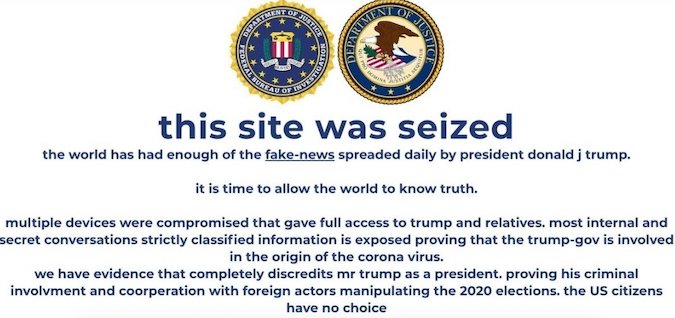
According to WordPress security solutions provider Defiant, which develops the Wordfence product, the hackers most likely used compromised credentials for access, supposedly targeting the underlying Expression Engine content management system (CMS), which is an alternative to WordPress.
While the site content was quickly restored, the “Privacy Policy” and “Terms & Conditions” pages were still delivering a “404 page not found” error hours after the incident was resolved.
“This indicates that something changed on the content management system itself, rather than on the Cloudflare configuration. So we believe that the CMS being compromised is therefore a higher probability than Cloudflare being compromised,” Defiant notes.
The site uses Cloudflare as a content delivery network (CDN), and Defiant says that this could have been used as a point of access only if the attackers knew the IP of the server hosting the site, which is hidden. Thus, this attack vector is less likely to have been used.
If the attackers had access to the campaign’s Cloudflare account and were able to point the domain to their own IP address, the entire website would have been restored by simply pointing it to the right IP address.
However, the issues with the “Privacy Policy” and the “Terms & Conditions” pages suggest this was not the attack vector.
Of even lower probability would be the use of compromised credentials to access the account where the domain donaldjtrump.com was registered; a possible access via FTP or SSH (would require not only FTP or SSH credentials, but also knowledge of the site’s origin IP address); or the use of a zero-day flaw in Expression Engine, which has had few known vulnerabilities, Defiant says.
“Almost every possible scenario includes reused credentials being exploited to gain access to the donaldjtrump.com site. In almost every case, having 2-Factor Authentication enabled would have prevented such a scenario from occurring. It’s also a reminder that it is important to enable 2-Factor Authentication not only on your website’s administrative panel, but on every service that offers it, including services you might not think of as being vulnerable,” Defiant concludes.
The attack comes shortly after a Dutch security researcher claimed that he gained access to Donald Trump’s Twitter account by guessing its password, which he said was “maga2020!”. The White House and Twitter have denied the claims and the researcher has yet to provide any definitive proof.
Related: Trump Campaign Website Broken Into by Hackers
Related: U.S. Charges Hackers for Defacing Sites in Response to Killing of Qasem Soleimani
Related: Researchers Unmask Brazilian Hacker Who Attacked Thousands of Websites
Related: Researchers Turn Comcast TV Remote Into Spying Device






