Many organizations around the world have been targeted in attacks that leveraged legitimate tools for fileless infections and traffic tunneling, Kaspersky Lab reported on Wednesday.
Malicious actors are increasingly using malware that works directly from memory and legitimate software – both open and closed source – to make detection and incident response more difficult for defenders.
While analyzing an attack aimed at a bank, Kaspersky experts discovered that the attackers had used several legitimate applications, without any actual malware, to achieve their goal. The security firm later identified more than 140 similar attacks aimed at banks, telecom companies and government organizations in the United States, the United Kingdom, France, Ecuador, Kenya, Brazil, Spain, Israel and 32 other countries.
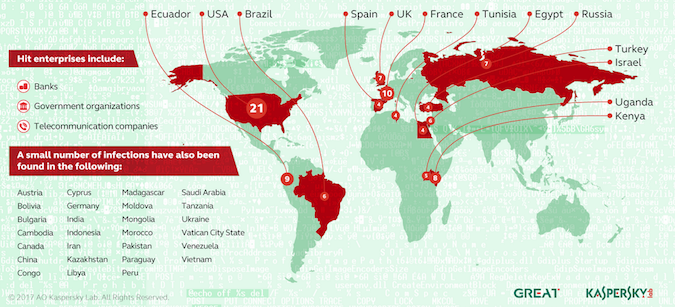
The cybercriminals leveraged an exploit for a known vulnerability to breach the servers of the targeted organizations. Once they gained access, they used the Mimikatz exploitation tool to obtain credentials that would provide them the elevated privileges needed to execute the other tools.
They then used PowerShell scripts, components of the Metasploit framework (e.g. Msfvenom and Meterpreter), and the standard Windows tool Sc to deploy malicious code in memory. Another standard Windows utility, Netsh, allowed the hackers to set up a proxy tunnel that could be used to communicate with the command and control (C&C) server and remotely control the infected host.
Since the malicious code is stored only in memory and the Windows registry, nearly all traces of the attack disappear after a reboot of the device, making detection and forensic analysis difficult.
The tactics, techniques and procedures are similar to the ones of the cybercrime groups known as Carbanak and GCMAN, but the lack of evidence left behind by the attackers makes attribution difficult and researchers could not confirm that all the attacks were launched by the same actor.
“Techniques like those described in this report are becoming more common, especially against relevant targets in the banking industry. Unfortunately the use of common tools combined with different tricks makes detection very hard,” explained Kaspersky researchers.
“After successful disinfection and cleaning, it is necessary to change all passwords. This attack shows how no malware samples are needed for successful exfiltration of a network and how standard and open source utilities make attribution almost impossible,” they added.
Related: Hackers Use Basic Tools After Breaching Your Network
Related: Attackers Increasingly Abuse Open Source Security Tools