Atmos, a derivative of the ZeuS/Citadel stable, has been detected targeting banks in France. The malware has been active since late 2015, but this seems to be its first concerted use.
Citadel was itself a highly successful derivative of ZeuS. According to the FBI, it had “infected over 11 million computers worldwide,” and had contributed to “over $500 million in losses.”
Following the Microsoft disruption of 1400 Citadel botnets in 2013, and the sentencing of its author, Russian national Dimitry Belorossov, to 54 months in prison a few months later, it had been hoped that Citadel was gone.
But now Danish firm Heimdal Security has issued a new alert, describing Atmos as Citadel’s polymorphic successor, and warning that although it is only recently active, it already comprises more than 1000 bots.
So far only a few strains have been discovered; but with one common factor – they are all being used to target banks in France. “Consequently,” notes Heimdal, “we can infer that this new financial malware strain is after the same objectives: money and confidential data.” The implication is that there is at least one criminal gang currently operating an Atmos campaign.
Atmos employs the same ‘web inject’ approach used by ZeuS to effect its financial thefts. It modifies the browser’s view of web pages and alters transaction details. A compromised user thinks he is doing one thing, but is actually doing something completely different – like invisibly transferring a sum of money to a bank account controlled by the attacker.
“The problem,” Heimdal’s CEO Morten Kjaersgaard told SecurityWeek, “is that IT administrators and end users simply don’t realize that they are infected with this type of financial malware. Meanwhile, the malware continues to steal user information from their machines.”
Even when antivirus detects it, and the users realize that they were infected, they often don’t question how long the infection has been sitting in their system, and how much data it might have harvested.
“With Atmos, this new Citadel-based strain that is now going polymorphic,” he continued, “this problem will just increase.”
Users and IT administrators need a good password management system in place, and should change their passwords as soon as they discover such a silent infection. “It’s also critical that they verify their bank statements and transactions immediately,” he concluded.
Heimdal’s analysis of the top ten financial malware threats in 2014 had only one entry, at number 10, that was not either ZeuS or Citadel or another ZeuS-derivative. That tenth malware was CryptoLocker at the beginning of the ransomware scourge. Notably, Atmos is being delivered with Teslacrypt v4 – the latest version of a ransomware that Heimdal describes as employing “unbreakable encryption and enhanced data-stealing capabilities.” However, if Atmos becomes anything like as successful as its predecessors, then this is the beginning of a major new threat.
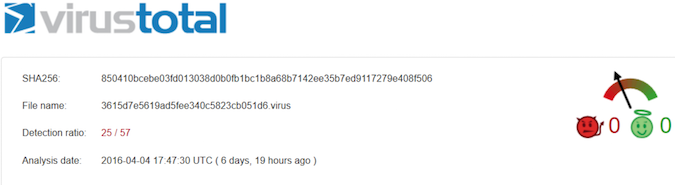
One saving grace is that the AV industry is already good at detecting Atmos, with 25/57 signature engines (and probably more by now) able to detect it.