Microsoft has unveiled its first cybersecurity AI model, MAI-Cyber-1-Flash, which the company claims got significantly better results in finding vulnerabilities than its main competitors.
MAI-Cyber-1-Flash, designed to identify challenging vulnerabilities in complex code, has been integrated into Microsoft’s MDASH multi-agent vulnerability identification and remediation harness.
MDASH orchestrates more than 100 specialized AI agents across multiple frontier and distilled AI models, and has been used to find many vulnerabilities in the tech giant’s own codebases.
According to Microsoft, testing in the CyberGym cybersecurity evaluation framework showed that MAI-Cyber-1-Flash (in combination with MDASH and GPT-5.4) topped Google’s recently launched 3.5 Flash Cyber, OpenAI’s GPT-5.6 Sol, and Anthropic’s Mythos 5 in vulnerability discovery.

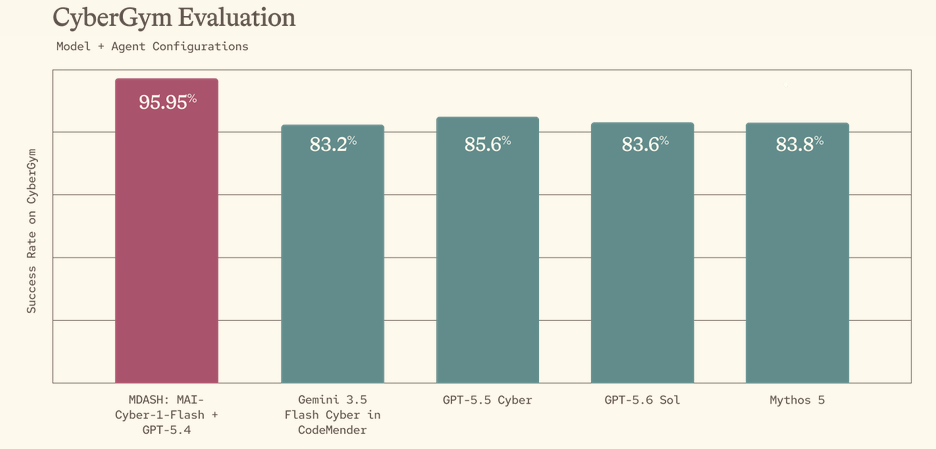
“MAI-Cyber-1-Flash was designed to efficiently handle up to 90% of all tasks, enabling MDASH to use the larger and most costly models in our fleet (in this case GPT-5.4) for the 10% of exceptionally hard tasks that truly need them,” Microsoft explained.
The company added, “This combination delivers a 50% cost saving when compared against our best offering in MDASH today (GPT 5.4 + 5.4 mini + 5.3 codex). That’s the power of a well-tuned, multi-model system with access to uniquely rich historical training data.”
MAI-Cyber-1-Flash is being offered through Project Perception, an agentic security offering that enables organizations to simulate attacks, detect and investigate threats, and fix vulnerabilities. Project Perception will enter public preview on August 3.
“We see across identities, endpoints, applications, data, clouds and AI systems, providing broad visibility across the digital estate. Equally important, we can help customers take action across those environments,” Microsoft noted.
Learn More at the AI Risk Summit | Ritz-Carlton, Half Moon Bay


Related: Nvidia and Tech Giants Launch AI Security Alliance
Related: OpenAI Says Its AI Models Broke Loose and Hacked Hugging Face
Related: Anthropic’s Opus 5 Nears Mythos 5 on Finding Bugs, but Falls Short on Exploits
Related: Nuclear-Sabotage Malware Benchmark Trips Up Most Frontier AI Models