Connect with us

Hi, what are you looking for?

SecurityWeekSecurityWeek

Application Security

XSS Flaws Decline, DoS Becomes More Common: Imperva

Security firm Imperva has analyzed web application vulnerability trends in 2016 and determined that while some types of flaws have declined, others have become more common.

Security firm Imperva has analyzed web application vulnerability trends in 2016 and determined that while some types of flaws have declined, others have become more common.

Data collected by the company shows that the total number of vulnerabilities found over the past two years has increased, but the number of flaws affecting web applications has actually dropped.

Imperva believes this trend can be attributed to a shift in research focus (e.g. towards IoT devices), and is likely not caused by web applications being more secure than before. Furthermore, the company pointed out that its data sources don’t cover vulnerabilities in proprietary web application code.

More than a quarter of the flaws tracked by the company have been classified as high priority, indicating that they pose a serious risk to affected systems.

When it comes to vulnerabilities by attack type, Imperva has observed a significant increase in denial-of-service (DoS) bugs, but the rate of cross-site scripting (XSS) issues has declined over the past year. Buffer overflows also increased slightly in 2016, but directory traversals, remote file inclusion, cross-site request forgery (CSRF) and SQL injections remained at roughly the same levels.

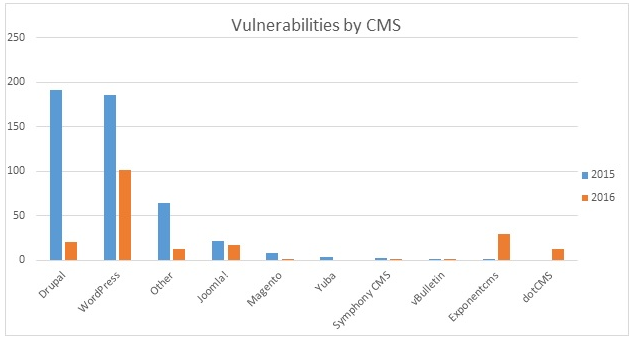
As for vulnerabilities related to content management systems (CMS), the number of issues affecting Drupal and WordPress dropped significantly in 2016 compared to the previous year, but the number of flaws identified in less popular products, such as Exponent and dotCMS, has increased.

Advertisement. Scroll to continue reading.

Experts believe CMSs with a smaller market share might have a larger proportion of flaws as a result of fewer resources and less investment in security.
CMS vulnerabilities

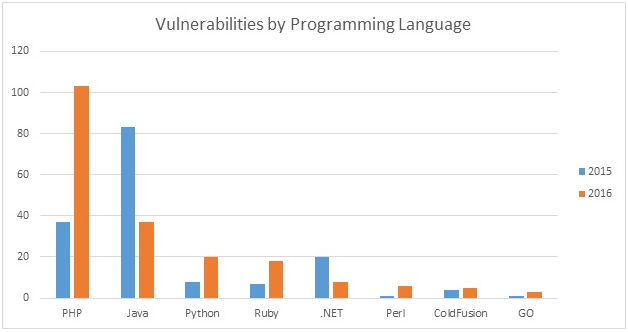
Imperva has found that the number of vulnerabilities affecting programming languages such as PHP, Python, Ruby, Perl, ColdFusion and Go has increased in 2016 compared to 2015. PHP takes the lead in this category with a growth of more than 100 percent. The security firm believes this can be attributed to the release of a new PHP version in December 2015.
Programming language flaws

Related: Brute Force Attacks on WordPress Websites Soar

Related: Over 8,800 WordPress Plugins Have Flaws, Study Shows

Related: Joomla Patches Dangerous Security Flaws

Written By

Eduard Kovacs (@EduardKovacs) is senior managing editor at SecurityWeek. He worked as a high school IT teacher before starting a career in journalism in 2011. Eduard holds a bachelor’s degree in industrial informatics and a master’s degree in computer techniques applied in electrical engineering.

Daily Briefing Newsletter

Subscribe to the SecurityWeek Email Briefing for the latest cybersecurity threats, trends, and expert insights.

Click to comment

Trending

Daily Briefing Newsletter

Subscribe to the SecurityWeek Email Briefing to stay informed on the latest threats, trends, and technology, along with insightful columns from industry experts.

Join this live webinar as we break down why email-layer defenses alone can't keep pace with the modern phishing ecosystem, how agentic AI is changing the capacity equation for security teams, and more.

Register

This year's summit will help organizations learn how to utilize tools, controls, and design models needed to properly secure cloud environments. Interact with leading solution providers and other end users facing similar challenges in securing a variety of cloud deployments.

Register

People on the Move

Sherrod DeGrippo has been appointed Head of Threat Intelligence for Palo Alto Networks Unit 42.

Christopher Porter has joined Booz Allen Hamilton as Global Chief Information Security Officer.

Yael Ben Arie has joined exposure validation company Pentera as Chief Product Officer.

More People On The Move

Expert Insights

Daily Briefing Newsletter

Subscribe to the SecurityWeek Email Briefing to stay informed on the latest cybersecurity news, threats, and expert insights. Unsubscribe at any time.