Thousands of devices have been hacked by a Linux malware named Rakos, and while researchers have yet to see any actual malicious activity involving the botnet, they believe it could be used for powerful distributed denial-of-service (DDoS) attacks.
Rakos, whose existence was brought to light in December 2016 by ESET, targets Linux systems by launching brute-force attacks via SSH. The security firm reported at the time that the compromised machines had not been leveraged for DDoS attacks or spam campaigns, as one might expect.
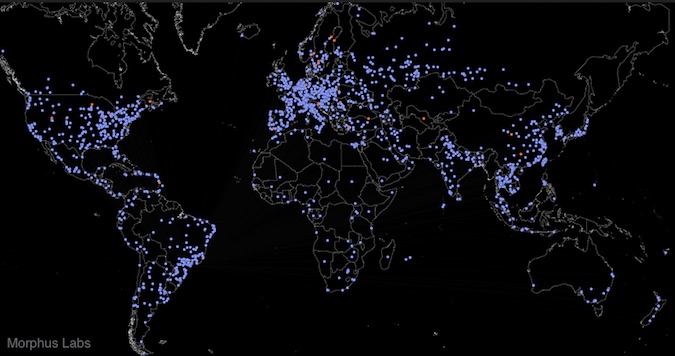
Brazil-based Morphus Labs recently deployed some high interaction honeypots that were quickly targeted by Rakos. A closer analysis revealed that the botnet had ensnared roughly 8,300 devices per day across 178 countries.
Rakos consists of bots and command and control (C&C) servers, but since it’s a peer-to-peer botnet some infected machines may play both these roles. Rakos bots obtain a list of IP addresses from a C&C server and attack those hosts via SSH. Each compromised device will in turn target other devices.
The botnet has been described as “transient” due to the fact that the infection is not persistent after a reboot of the hacked device.
Morphus Labs researchers analyzed the botnet by using crawlers and by injecting fake nodes to act as sensors. Data collected over the course of 72 hours revealed the existence of just over 25,000 unique infected devices, or roughly 8,300 per day. This includes nearly 300 machines that served as C&C servers.
The country with the highest number of nodes was China (3,300), followed by Vietnam, Taiwan, Thailand, Russia, India, Brazil and the United States, which had just under 1,000 unique infections.
Experts determined that more than 45 percent of the compromised devices were Raspberry Pis, followed by Open Embedded Linux Entertainment Center (OpenELEC) systems, which also typically run on Raspberry Pi. Unsurprisingly, the third most targeted systems are wireless access points from Ubiquiti Networks, which are often targeted by cybercriminals.
The Rakos botnet can hack devices because their owners have neglected to set strong passwords, but researchers pointed out that, in some cases, such as OpenELEC, default SSH passwords cannot be changed by users.
While 8,000 bots might not seem much, Morphus noted that a new Mirai variant recently used a similar number of compromised devices to launch a significant DDoS attack on a U.S. college. The attack lasted for 54 hours and peaked at 37,000 requests per second (RPS).
However, there is currently no evidence of malicious activity coming from Rakos, except for the brute-force SSH attacks.
“It seems that someone is preparing it to be sold or to offer ‘services’ using it when it gets in the right size,” explained Renato Marinho, director of research at Morphus Labs. “Thinking this way, the innocuous-looking may be a strategy to fly under the radar.”