
Connect with us

Hi, what are you looking for?

SecurityWeekSecurityWeek

Email Security

Google Boosts Account Security With New Tools, Protections

Google on Wednesday announced several new tools and protection mechanisms designed to help users secure their accounts and recover them in case they have been compromised.

Google on Wednesday announced several new tools and protection mechanisms designed to help users secure their accounts and recover them in case they have been compromised.

It’s not uncommon for accounts to get hacked after their username and password have been obtained by malicious actors through phishing attacks. Since many users still haven’t enabled two-factor authentication, Google has introduced an additional layer of security during the login process.

When the username and password are entered on the sign-in page, a risk assessment is run and the login is only successful if nothing is suspicious. However, for the risk assessment to work, Google says users need to have JavaScript enabled.

The tech giant pointed out that JavaScript is enabled by default in most web browsers, but noted that 0.1% of its customers have decided to disable it. If JavaScript is disabled and the risk assessment cannot be completed, authentication will fail.
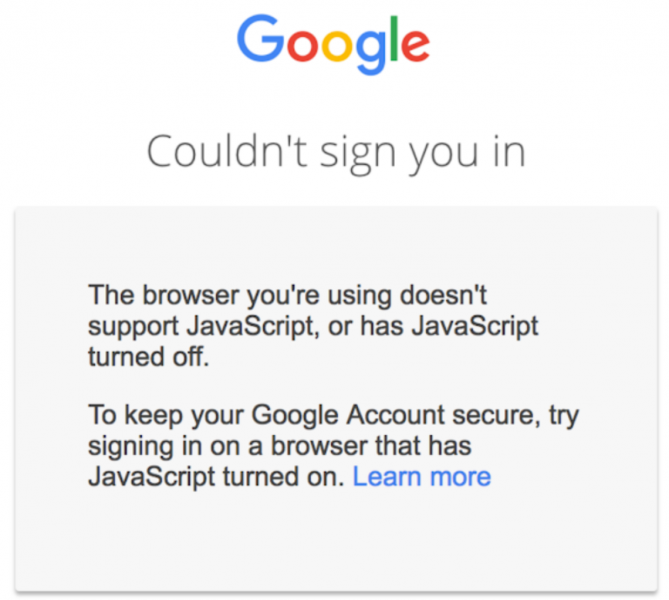
Google requires users to enable JavaScript when accessing their account

Once users have logged in, the Security Checkup tool introduced by Google last year helps them improve the security of their account by offering customized guidance. The tool is constantly enhanced and the company recently added protection against harmful mobile apps based on recommendations from Google Play Protect. It now also allows users to remove their account from devices they no longer use.

While Google currently notifies users when third-party sites or apps are given access to Gmail and Google Contacts data, the company says it will soon add Google Accounts to the list.

Advertisement. Scroll to continue reading.

In case an account has been compromised, Google now provides a step-by-step process that helps users check security settings, protect other accounts linked to the hacked account, verify financial activity to see if payment methods linked to the account have been abused, and review files in Gmail and Drive to determined if they have been accessed or misused.

Related: Google Announces New Security Tools for Cloud Customers

Related: Google Offers G Suite Alerts for State-Sponsored Attacks

Related: Google Tracks Your Movements, Like It or Not

Related: Google Launches reCAPTCHA v3

Written By

Eduard Kovacs (@EduardKovacs) is senior managing editor at SecurityWeek. He worked as a high school IT teacher before starting a career in journalism in 2011. Eduard holds a bachelor’s degree in industrial informatics and a master’s degree in computer techniques applied in electrical engineering.

Daily Briefing Newsletter

Subscribe to the SecurityWeek Email Briefing for the latest cybersecurity threats, trends, and expert insights.

Click to comment

Trending

Daily Briefing Newsletter

Subscribe to the SecurityWeek Email Briefing to stay informed on the latest threats, trends, and technology, along with insightful columns from industry experts.

Join this live webinar as we explore why exploitation is outpacing remediation, where risk is growing fastest, and what security leaders can do to close the gap before attackers take advantage.

Register

CodeSecCon bridges the gap between dev and security. Discover best practices for secure coding, innovative risk-reduction tools, and safe AI integration to cultivate a true DevSecOps culture. Safely secure your apps!

Register

People on the Move

Alex Levinson has been named Executive Director at the National Collegiate Cyber Defense Competition.

Hack The Box has appointed Konstantinos Dolkas as CTO and has promoted Christine Bartlett to CMO.

The Department of Energy has appointed Andrew McClure as Director of the Office of Cybersecurity, Energy Security, and Emergency Response (CESER).

More People On The Move

Expert Insights

Daily Briefing Newsletter

Subscribe to the SecurityWeek Email Briefing to stay informed on the latest cybersecurity news, threats, and expert insights. Unsubscribe at any time.





