
Web performance and security solutions provider CloudFlare announced on Tuesday the availability of a new service designed to protect DNS nameservers against distributed denial-of-service (DDoS) attacks.
The product, dubbed Virtual DNS, is an authoritative DNS proxy service that provides mitigation against DDoS attacks and global distribution for DNS traffic.
DDoS attacks have become increasingly problematic. A report published by Incapsula in November revealed that such attacks, on average, cost organizations $40,000 per hour.
Attacks aimed at DNS nameservers can be highly damaging since they can lead to the disruption of all the websites with DNS records on the targeted server. In the case of major service providers, a successful attack can result in hundreds of thousands and even millions of websites going offline.
Many DNS providers are unable to provide customers with modern cloud-based security services because of their legacy DNS infrastructure. CloudFlare says the issue can be addressed with Virtual DNS.
Virtual DNS ensures that queries for DNS records don’t go directly to the origin nameserver. Instead, they go to the nearest CloudFlare edge location where the response might be available in cache. If the response is not available in cache, CloudFlare queries the provider’s nameservers to get the response. Once a response is fetched, it’s cached by CloudFlare for future queries.
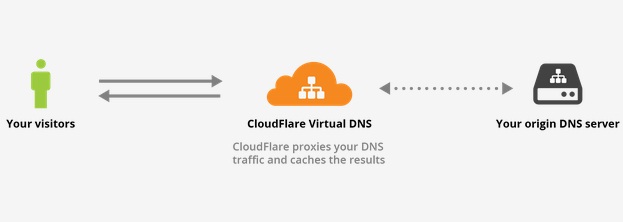
“To protect against attacks, malicious requests to the nameservers will be identified and blocked at CloudFlare’s edge before those requests ever make it to the provider’s DNS infrastructure,” CloudFlare’s Dani Grant explained in a blog post.
In case the origin nameserver goes down, DNS answers are still provided as long as the records are in CloudFlare’s cache, the company explained.
Furthermore, by using Virtual DNS, service providers mask the IP addresses of their nameservers to protect them against malicious operations. Users and attackers will only be able to see CloudFlare’s IP addresses, instead of the true origin IP.
“DigitalOcean, for example, put their nameservers behind Virtual DNS in July 2014, and is now supporting 10K requests per second of 100% clean traffic. They report that they haven’t seen malicious traffic reach their nameservers since,” Grant said.






